


- 3D Printing Post-Processing: What Engineers Should Know - September 18, 2026
- MJF vs. SLS: Find the Best Process for Better Parts - September 4, 2026
- 3D Printing for End Use Parts: A Smarter Choice - August 21, 2026
Multi Jet Fusion (MJF) and Selective Laser Sintering (SLS) are two leading technologies for producing technologies for producing strong, functional plastic parts. Both processes use a powder bed, support complex geometries, and eliminate the need for dedicated support structures. However, they do not produce identical results.
The right choice depends on your material requirements, part design, production quantity, surface finish, and performance goals.
This guide compares MJF vs. SLS 3D printing to help you determine which additive manufacturing process is better suited to your application.
What is MJF 3D Printing?
Multi Jet Fusion is an industrial power-bed 3D printing process developed by HP. It uses an inkjet array to deposit fusing and detailing agents across a thin layer of polymer powder.
Thermal energy then passes over the powder bed. Areas treated with the fusing agent absorb the energy and fuse together. The detailing agent helps control the boundaries of the part and improves feature definition.
The machine repeats this process layer by layer until it completes the build.
MJF can produce strong, detailed parts at production speeds. Manufacturers commonly use it for functional prototypes, assemblies, housings, brackets, jigs, fixtures, and end-use components.
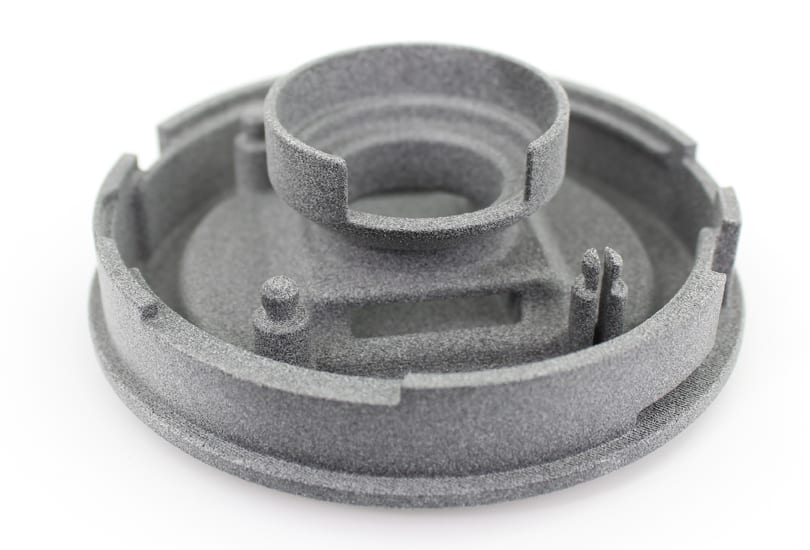
What is SLS 3D Printing?
Selective Laser Sintering is another industrial powder-bed fusion process. Instead of applying fusing agents, SLS uses a laser to selectively fuse polymer powder. After the laser completes one cross-section, the machine spreads another layer of powder across the build area. The laser then fuses the next layer. This cycle continues until the parts are complete.
SLS can produce a durable components with complex shapes and internal features. The process has a long history in industrial additive manufacturing and offers access to a broad selection of materials.
Manufacturers use SLS for functional prototypes, low-volume production parts, duct, enclosures, clips, connectors, medical components, and other demanding applications.

What is the Difference Between MJF and SLS?
The primary difference between MJF and SLS is how they fuse the powder.
SLS uses a laser to trace each part’s cross-section. MJF distributes using agents across the entire layer before applying thermal energy. This difference influences production speed, surface appearance, feature definition, material availability, and part consistency.
| Consideration | MJF | SLS |
| Fusion method | Fusing agents and thermal energy | Laser energy |
| Common materials | PA 12, PA 11, and TPU | Nylon and a wider selection of specialty polymers |
| Natural appearance | Typically gray | Commonly white or off-white |
| Surface texture | Fine, slightly grainy texture | Slightly rough or powdery texture |
| Mechanical performance | Strong and relatively consistent in multiple directions | Strong functional performance that depends on the material and build |
| Complex geometry | Excellent | Excellent |
| Support structures | Not required | Not required |
| Production use | Well suited to repeatable production quantities | Well suited to prototypes and production parts |
| Color finishing | Commonly dyed black or other colors | Light natural parts offer flexible dyeing options |
These are general guidelines. The results of either process depends on the material, equipment, build parameters, geometry, orientation, and finishing method.
MJF vs. SLS Materials
Material selection can determine which process makes the most sense for your project.
Common MJF Materials
MJF commonly uses engineering-grade thermoplatics such as
- PA 12
- PA 11
- Glass-filled PA 12
- TPU
PA 12 provides a useful balance of strength, stiffness, chemical resistance, and dimensional stability. It is a strong option for housings, brackets, fixtures, and other functional parts.
PA 11 offers greater flexibility and impact resistance. TPU is appropriate for components that require elasticity, such as seals, protective covers, and flexible connectors.
Available materials vary by equipment and manufacturing provider.
Common SLS Material
SLS also works with PA 12 and PA 11. Depends on the equipment and supplier, it may provide additional specialty materials, including:
- Glass-filled nylon
- Mineral-filled nylon
- Flame-retardant materials
- Carbon-filled polymers
- Flexible thermoplastic materials
- High-temperature polymers
SLS may be the stronger choice when a project requires a specialized material that is not available for MJF.
However, engineers should avoid choosing between MJF and SLS based only on a material’s general name. Review the specific material grade and data sheet. Tensile strength, heat resistance, flexibility, chemical resistance, and certification requirements can vary significantly.
Which Process Produces Stronger Parts?
Both MJF and SLS can produce strong parts for functional testing and end-use applications. Neither process is automatically stronger in every situation.
MJF parts often provide consistent mechanical properties across different build directions. This can benefit components that experience loads from multiple directions
SLS parts can also provide excellent strength and durability. Their performance depends heavily on the selected material, build orientation, machine settings, and part geometry.
When comparing strength, consider the complete application:
- Where will the load occur?
- Is the load continuous or occasional?
- Will the part experience impact or vibration?
- Does it require flexibility?
- Will it encounter heat, moisture, or chemicals?
- Are there thin walls or stress concentrations?
- How long must the component remain in service?
A material data sheet provides a valuable starting point, but it does not replace application-specific testing. End-use parts should be tested under the same loads and environmental conditions they will experience in service.
Surface Finish and Appearance
MJF and SLS parts both leave the machine with a slightly texture surface. Because the processes begin with powder, neither creates a perfectly smooth, injection-molded appearance without additional finishing.
MJF parts commonly have a uniform gray appearance. The can be dyed, painted, coated, polished, or vapor smoothed depending on the material and final requirements.
SLS parts are often white or off-white in their natural state. Their lighter starting color can provide greater flexibility for dyeing parts in different colors. SLS surfaces may feel somewhat rougher or more powdery before finishing. Available post-processing options can include:
- Media blasting
- Dyeing
- Painting
- Vapor smoothing
- Polishing
- Protective coatings
- Assembly and hardware installation
If the part has an important cosmetic surface, identify it before production. Build orientation and finishing requirements can affect appearance, dimensional results, cost, and lead time.
Feature Detail and Dimensional Accuracy
Both processes can produce complex parts, but MJF often provide sharp feature definition and consistent dimensions across a production build.
- Snap fits
- Clips
- Text or identification marks
- Thin walls
- Small functional features
- Mating surfaces
- Repeated production geometries
SLS can also create detailed features and complex components. Its suitability depends on the machine, powder, feature size, and orientation.
Very small holes, thin walls, narrow channels, and tight gaps can behave differently than they appear in the CAD model. Powder may become trapped inside enclosed spaces, and thin features may distort or break during cleaning.
Very small holes, thin walls, narrow channels, and tight gaps can behave differently than they appear in the CAD model. Powder may become trapped inside enclosed spaces, and thin features may distort or break during cleaning.
Before production, confirm the manufacturer’s design guidelines for:
- Minimum wall thickness
- Minimum hole diameter
- Clearance between moving parts
- Text and embossed features
- Escape holes
- Dimenstional tolerances
- Maximum unsupported spans
Adding unnecessary precision can also raise costs. Apply tight tolerances only to features that require them for fit or function.
Design Freedom and Support Structures
One major advantage of both MJF and SLS is that the surrounding powder support each part during printing. Separate support structures are generally unnecessary.
This enables both processes to produce:
- Internal channels
- Lattice structures
- Organic shapes
- Undercuts
- Interlocking components
- Assemblies printed as one unit
- Lightweight internal structures
- Part consolidations
Removing support structures can reduce manual labor and provide more design freedom than processes that require attached supports.
However, the loose powder must still be removed after printing. Long internal channels and enclosed cavities may trap powder. Designers should include access points or escape holes where necessary.
Production Volume and Repeatability
MJF and SLS can both support low-volume and repeat production. The best option depends on part size, nesting efficiency, material, and total quantity.
MJF is often a strong choice for repeatable production runs. Its layer-wide processing method can make efficient use of full builds containing many parts. It also provide consistent mechanical and dimensional results when the process is properly controlled.
SLS remains an effective option for prototypes, replacement components, custom products, and low-volume production. It may offer an advantage when the application requires a specialty material or when the production setup is better suited to a specific SLS platform.
For ongoing production, evaluate more than the price of one build. Consider:
- Repeatability between builds
- Inspection requirements
- Finishing consistency
- Material availability
- Production capacity
- Part traceability
- Expected annual quantity
- Backup production options
A successful production program requires a process that can consistently meet the same specifications over time.
MJF vs. SLS Cost
There is no universal rule that makes MJF or SLS less expensive for every project.
Several factors influence the final cost:
- Part dimensions
- Total material volume
- Build height
- Production quantity
- Packing efficiency
- Material selection
- Finishing requirements
- Inspection requirements
- Cleaning labor
- Shipping schedule
Powder-bed processes can often nest multiple parts throughout the build volume. This means the cost does not depend only on the footprint of an individual part. The manufacturer must consider how effective the entire build can be packed.
A compact part that nests well may be economical at higher quantities. A large part that occupies a significant portion of the build may cost more even if its geometry appears simple.
The most reliable comparison comes from quoting the same design in both processes using the required material, finish, quantity, and tolerances.
When Should You Choose MJF?
MJF may be better choice when your project requires:
- Consistent production parts
- Strong mechanical performance
- Good feature definition
- Dense builds with many components
- PA 12 or another supported MJF material
- Functional prototypes that closely represent production parts
- Repeat orders with reliable dimensional results
- Black-dyed or finished end-use components
MJF is particularly valuable when a company wants to move from prototyping into additive production without investing in injection molding tooling.
When Should You Choose SLS?
SLS may be a better choice when your project requires:
- A specialty material available through SLS
- Complex functional prototypes
- Durable nylon parts
- Natural white or custom-dyed components
- Flexible or high-temperature material options
- Large or unusually shaped powder-bed parts
- A proven process for a specific regulated or demanding application
SLS can also be a better fit when a specific material property matters more than production speed or natural surface appearance.
MJF vs. SLS: How Do You Make the Final Decision?
Start with the requirements of the part rather with the name of the technology
Ask these questions:
- What loads must the part withstand?
- Which material properties are essential?
- Will the component encounter heat, chemicals, moisture, or UV exposure?
- Are any surfaces cosmetic?
- Which dimensions are critical?
- How many parts are needed now?
- Will the project require repeat production?
- Does the part need post-processing or assembly?
- Are there documentation or certification requirements?
- What is the target cost per part?
In many cases, both MJF and SLS can manufacture the design. The decision then comes down to the best combination of material performance, consistency, finish, cost, and availability.
Find the Right Additive Manufacturing Process
Choosing between MJF and SLS does not have to be a guessing game. A knowledgeable additive manufacturing partner can review your CAD file, material requirements, quantity, and application before recommending a process.
Uptive Manufacturing supports customers from early prototypes through repeat production. Our additive manufacturing team can help you compare technologies, improve part manufacturability, select materials, and plan the right finishing steps.
Ready to compare MJF and SLS for your next project? Upload your design file to Uptive to receive expert guidance and request and request a quote.